Cacique Update October 1, 2011

by Cacique Ian Huschle

Saturday was a big day. We began at 6:30 AM with the long Saturday morning exercise. I’m on swim track for the semester, and to train for the 4-mile swim, all of us on swim track swam to the current cut. The current cut is a short strip of water cut across the point of Cape Eleuthera, leading out of the marina, and the direction of the current changes with the tides. The current will get so fast it can feel like a class-one rapid. On Saturday, we tried to swim into the current. Most of us swam pretty far up the current cut, and a few others swam all the way to the end. This was just the start of a busy day. After breakfast was research class. I am in the patch reef research class, and a typical day consists of either discussing issues in the classroom, or going out snorkeling in the field. The field is right out of my dorm room window; the bright, blue, shallow water marine ecosystem. Continue reading

Lville Office Takes Point Pleasant By Storm

[slideshow] Congratulations to Mary Assini (S00), Hannah Mauck (F04) and Scotty Aland (S05) for their efforts in the Treasure Island Sprint Triathlon this past Sunday, October 2.  All first-timers, the three alumni donned their swim caps, bike shorts, and running shoes and showed ninety other participants what’s up. Mary took silver as the #2 female overall, while Hannah and Scotty took gold in their respective age groups. The shelves of the office are looking mighty shiny these days with some stellar new hardware, and the triathlon world will never be the same…

Congrats team!

–The Island School

F’11 First Flats Research Update

The Fall 2011 Flats Research program kicked off their first class with Sam Saccomanno, Annie Blanc, Kate Maroni, Tori Suslovitch, Brendan McDonnell, Franklin Rodriguez, and our research advisors, Justin, Liane, and Ally. The focus of our research group is to study and raise awareness about mangrove conservation.
[slideshow]
What are flats and mangroves? Flats are the area between land and sea where there is a broad surface level but shallow depth. Flats can be shallower than just a few centimeters and as deep as 2 meters. Mangroves are a plant species that thrive in the flats ecosystem and are very important on both an ecological and economic level. They are important nursery grounds and breeding sites for birds, fish, crustaceans, shellfish, reptiles and mammals, are renewable source of wood, accumulation sites for sediment, contaminants, carbon and nutrients, and offer protection against coastal erosion. Continue reading

Middlebury Solar Decathalon Team Finishes Fourth!

Congratulations to Katie Romanov (F’05) and the rest of Team Middlebury College for their impressive finish in the U.S. Department of Energy (DOE) Solar Decathalon 2011!

[slideshow]

Solar Decathlon is a biennial competition that challenges twenty collegiate teams from around the world to design and build net zero energy houses that are attractive, affordable and entirely solar-powered. Team Middlebury College’s entry, Self-Reliance, received 1st place in three of the ten decathlon contests: communications, home entertainment and market appeal.

As the first undergraduate liberal arts team ever to make it into the finals on their own, Team Middlebury College is extremely proud to have performed as a top contender amongst teams from technical architecture and engineering institutions. Right before the final results announcement in West Potomac Park on Saturday Oct. 1st, the team’s Communications Coordinator Katie Romanov ’11 commented, “If we could finish in the top five, and be the little engine that could, we’d be thrilled!”


Read the full press release here!

Cacique Update October 2, 2011

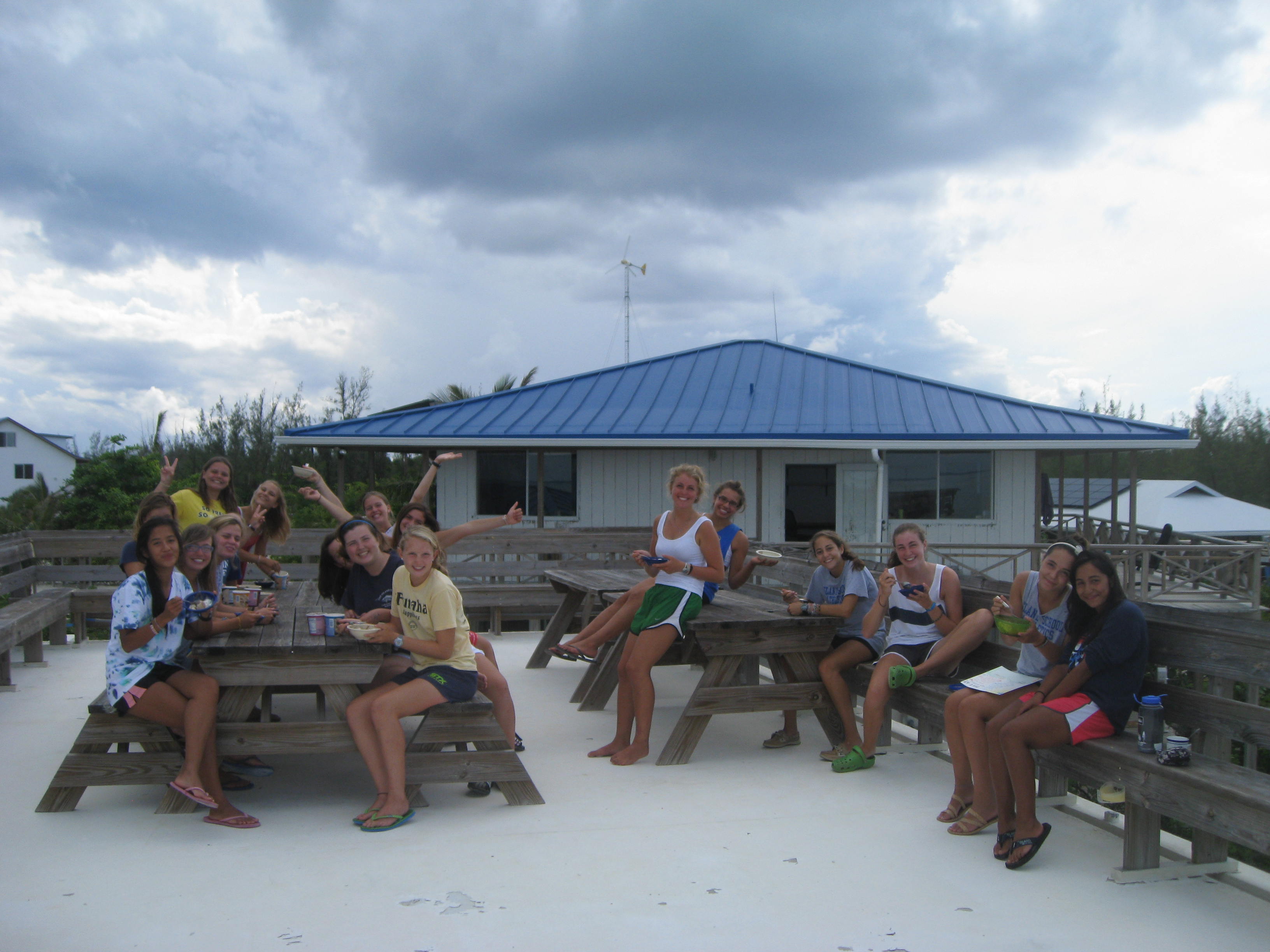
Being Cacique on my Birthday today was awesome, especially because it was a Sunday, and we got to sleep in and have exploration time almost all day. In the morning after everyone woke up around nine, the girls took a trip to High Rock to celebrate. The view was very relaxing and it was a great opportunity to even out farmer’s tans. After we went to brunch that day, my advisor, Peter, brought 6 pints of ice cream for girl’s dorm to share. I think everyone almost forgot what cold food tasted like, the girls were very happy, and the boys were a little jealous. For the rest of the day, people spent their time working on their Eleutheros, and Marine Ecology papers, and by dinner people were hungry for birthday cake, and since it was a Sunday and most of the faculty was off campus, students got as much as they wanted. My sweet sixteen was a lot more than I had expected it to be, and every one here took part to make it a great day.

F’11 First Lionfish Research Update

By Maddy Philipp and Katie Harpin

[slideshow]
Greetings from the Lionfish Research team! We are now three weeks into the program and have already learned so much. The purpose of our study is to look at how grouper and currents affect the distribution of invasive lionfish (Pterois volitans) found around Cape Eleuthera, Bahamas. So far we have gone on two mock dives. Unfortunately our second one got cut short due to an unexpected thunderstorm. We have also learned how to identify grouper and take the total length of fish from a distance underwater. For one of our classes, we took a trip to CEI and learned how to dissect a lionfish. From the dissection we could see what the lionfish had eaten. We also learned that lionfish can expand their stomachs up to 30 times its normal size. For another class we became scientist for a day and learned the correct structure for scientific papers. We have 3 research classes a week and two of those usually involve fieldwork. Although the readings may be strenuous, the lionfish team is excited to have the opportunity to work alongside biologists and helping to further the worlds knowledge on lionfish.

Cacique Update September 30, 2011

By Cacique Ihna

As our van pulled up beside a field covered with more rocks than open land, multiple “Are we here?” remarks filled the car. My scrutinizing eyes surveyed, in confusion, the surrounding area that appeared to be just a random unharvestable plot. Going to the “farm”, I had an image of big, open fields with neat rows of crops, but, instead, random blotches of fruit trees welcomed me. I was a bit ashamed of myself; all term, I have been learning to always keep an open mind and to try to rid all my preconceived notions but that is not what I did. I quickly thought of the farmer, Reverend Nixon, as someone who must have been careless, but, after I met him, I realized how industrious he actually is. Continue reading

Salutations to the Sunday

My alarm sounded. Confused, I turned it off and rolled over. Today is Sunday, the one day at The Island School when students and faculty alike take advantage of sleeping in. I was content nuzzling back into my pillows until I remembered: today was the day Griffin had asked me, or maybe convinced me, to lead yoga at the sandbar. I left my house in the dark noticing the silence of campus, the brilliance of the stars in the morning sky. Stepping into the boathouse I made out the silhouettes of students sitting with lifejackets as promised: 6:10 am and ready to go. We groggily filled two boats and headed out as the first glimpses of daylight shone through the clouds in the distance. The water was quiet, each movement of our boat breaking the steady silence of the sea. The pale pink of a sunrise reflected on the glassy surface as we all came to life. [slideshow] Continue reading

Need Support for November Shark Expedition!

Attention alumni! Edd Brooks, shark project manager, is in need of some support on his upcoming shark expedition and is looking to The Island School alumni network for help. November 6-18, Edd and his team will be in Little San Salvador to recreate shark surveys that were conducted in the late 1970s. Their goal is to identify any shifts in the diversity and abundance of sharks in the last 30 years. If you are interested in applying to join this expedition or have any other questions, please contact Edd at eddbrooks@islandschool.org by October 14th. Continue reading

Introduction to the F’11 Biodigestion Research Project

By Tyler Courville and Ihna Mangundayao

[slideshow]

Did you know that 5.2 million people die every year from waste related diseases? Now you do! This is a result of irresponsible and inappropriate global waste management – 50% of which is organic and 35% is unsorted recyclables. This is becoming a major problem in both developed and less developed countries with the latter usually suffering the consequences. Developed countries like the US often dump their trash in less developed countries that cannot always meet the waste demands. People have been trying to find alternative ways to dispose of waste more responsibly and sustainably. To solve this crisis, scientists turned to Nature for a solution – creating an emerging field known as biomimicry, which copies Nature’s processes to make the world a better place for humans. From this, a solution arose: Biodigestion. Continue reading