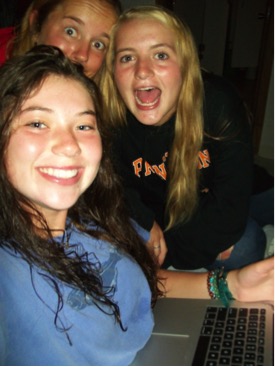
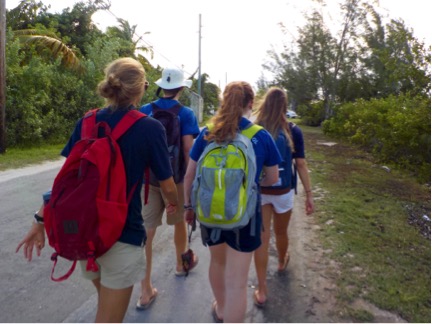
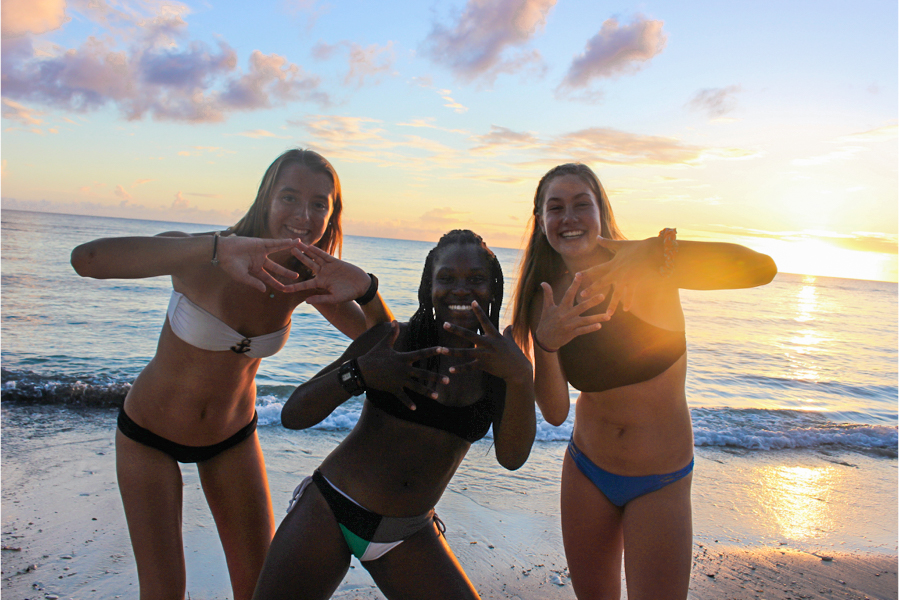
Katelyn (left) and her fellow dorm mates Melanie and Callie
Have you ever been to a place where you have 28 sisters? At home, I am the eldest child and I have a younger brother who is five years younger than me. I had gone to camp for 6 years and had lived in a cabin with 8 other girls, but I have never truly experienced dorm life quite like Island School girls’ dorm. All of the girls in both North and South dorm have a bond that is incomparable to any other friendship or sisterhood. We eat together, work together, dive together, sleep together, and have so much fun. There is no feeling quite like waking up next to your best friend for 100 days. In these past 3 months, the memories that have been made in the girls’ dorm are ones that I will never forget. Whether it is laughing so hard that someone pees or crying because of stress, we are always there for each other and have created the best support system there is. I love you Girl’s Dorm and I will never forget the time we spent together in our 100 days.
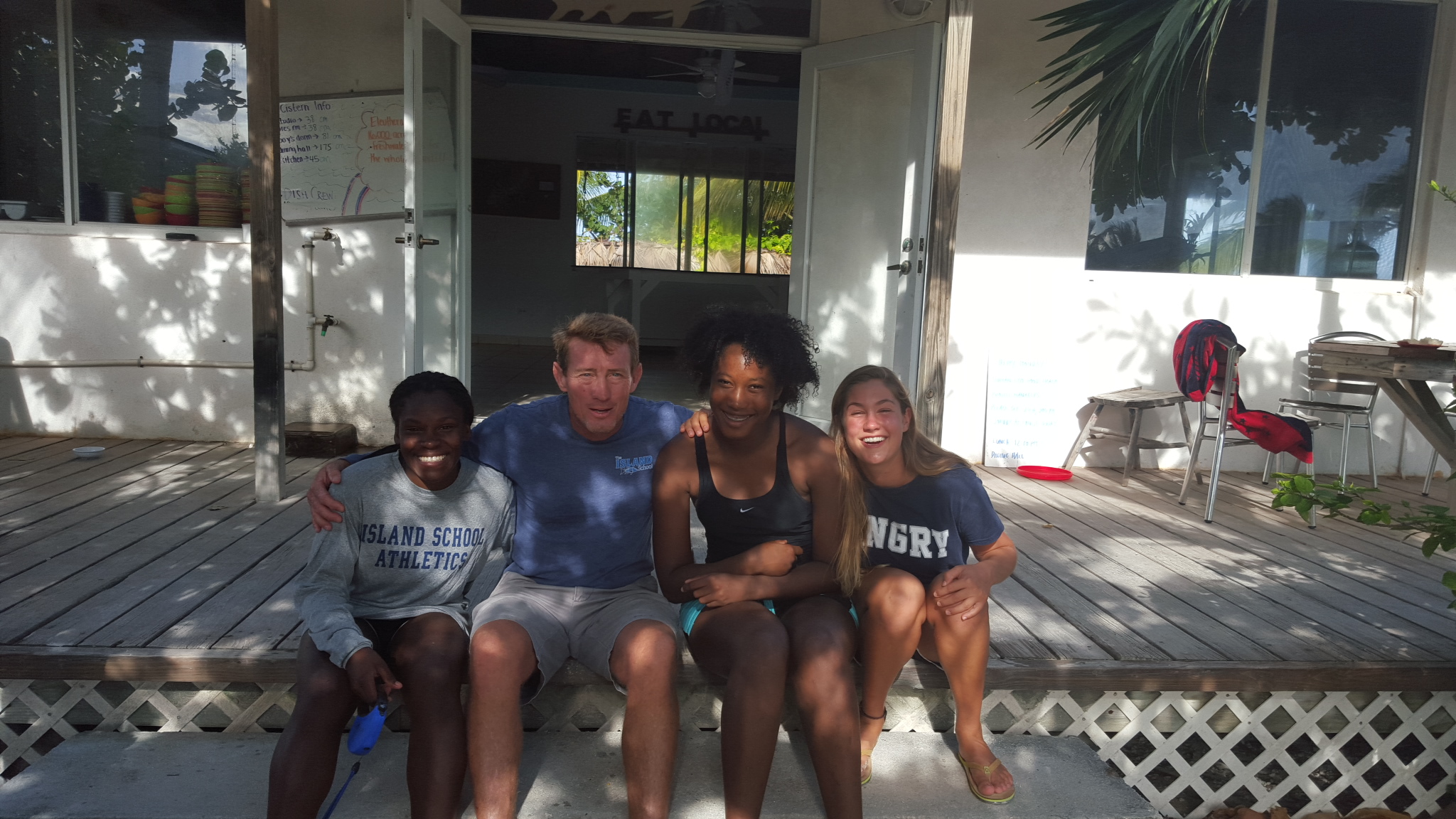
The dinning hall was empty. Andrieka, Aissatu and Rikki and I are in the photo. We just finished a sandwich and we are happy and tired. We successfully completed the four mile ocean swim!
A little before 8 AM we gather on Sunset Beach and circle with our new yellow swim caps and our swim buddies for a final stretch. All hands are in the middle palms facing up to promote positive energy for a last cheer. We enter the water and our support team, all who completed the half marathon the day before, are with us cheering from the beach and from kayaks and boats.
Andrieka is my buddy and through her huge smile I sense her courage and her fear. The count down launches us into the clear shallow water and the acute angle of the sun casts shadows across the rocky bottom. We pull together over reefs into a flooding current. We swim over lobsters and rays and an abundance of colorful fish darting out to see what is splashing above. We pass a curious barracuda and a shy reef shark.
When we peak out around the first point the turn-around boat seems so far away. On the cliffs our run team cheers us on and Catherine Klem is there watching over us in a kayak.
On the way back there are times when you might call the kayak over and quit. Andrieka finds hidden strength down the last stretch of beach and hits the finish float. The shore erupts with celebration.
Andrieka and I swam together for four and a half hours to finish. Rikki and her buddy Ian passed us way back. Max re-injured his right shoulder and swam most of the way with only one good arm and never considered pulling out. Aissatu could not swim when she arrived 97 days ago and she braved her way to the finish with her buddy Emma in just under 6 hours.
This is why we are so proud and why the dining hall is so quiet. The journey continues…..
When I was told I got to write a blog, I was excited to share some of the many amazing experiences I have had here at The Island School. Unfortunately early last week I ran into a tree during one of our run-swims, and got a concussion. Because of this I have not been able to write about what I anticipated writing about. So instead I would like to share a poem I wrote earlier this semester for literature class. I wrote this poem about how most of us will be going home to the cold very soon. For me personally, I often leave my snowy hometown, Jackson Hole Wyoming for a warmer climate, but always end up coming home and learning to love the snow time and time again.
Cold
Snow cascades to the ground
The golden leaves that were once on the trees are now buried until spring
Cold
The wind feels like a slap in the face as you walk out the door
You try to walk but the glistening ice stares you in the face
Cold
Your fingers are as blue as the sky
Your nose as red as the fire
Cold
You want to leave but
The snow pulls you back time after time
Cold
How many teenagers get to conduct research projects? This past week during Parents Weekend every Island School student did. In total there were 9 research projects which the 50 students were a part of, ranging from sea turtles to deep sea sharks.
Conducting a research project when you are only 16 is a pretty amazing feat. Students worked all semester on one of 9 projects: Conch, Stingray, Lemon Sharks, Deep Sea Sharks, Sea Turtle Habitat, Sea Turtle Knowledge, Plastics, Bonefish, and Ponds. Students worked with 4 or 5 of their peers to culminate a final project of a scientific poster and a presentation during Parent’s Weekend.
For our research project, we tested the behavioral and physiological responses to capture of a lemon shark. We were testing to see if the behavioral response had a relationship with the physiological response.
As much fun as it would be to drone on and explain our entire research project to you, I’d like to talk about the process. Trying to create a research presentation and poster, both which are at the collegiate level, is a daunting task when first presented.
When I first arrived at The Island School, I thought, “I’m excited to be here and am ready to learn, so is everyone else.” Team work was an important skill to learn. Being in the field chasing after a lemon shark is difficult alone, but if you work together, it becomes a lot easier. The same was true for work in class, if we split up the work, it got done better and quicker.
Before coming here, I was a driver leader, which means getting stuff done and I didn’t know how to be a spontaneous motivator and rally the troops. Working in a group with a topic I was passionate about (sharks), definitely improved my leadership skills.
In the end, our presentation went well and our poster looked great, it just took a couple bumps in the road to get there. To look at the posters and videos of the presentations, check out the CEI website and The Island School Research page.
At the Island school, there are three main pillars, community, sense of place and sustainability. Everyday in class, with friends, and with the challenges we take, we are working to fully understand these three ideals, and learning how to apply them to everyday life. The point of school for us is no longer learning facts to prepare us for the next test, but instead classes bring purpose and meaning into what we are learning. We look not only at what things are, but instead discuss why they came to be, and how it affects the world around us. This change from what we were used to at home all began on one of the first days at Island School, when early in the morning, we were taken down to Boys dorm beach, asked to grab a handful of sand, and told to rub it around our face, talk to it, and really understand it. We thought our teacher was crazy at first, but after a few minutes we were laughing at each other and were covered in sand from head to toe.
This was only the beginning, because now as a community we’ve learned how to laugh together, care for each other, and trust each other. As we went through our first 5 academic weeks, and were forced to be busier than ever before, we challenged ourselves to get to know each other better, and to get used to the routines of campus. This routine was then tossed out the window when 8-day kayak/sailing rotations started, and we were split up and stuck with a new group of kids (different from class groups) that we didn’t have a choice but to get along with. For a week we bonded over campfires and hardships until all of sudden we were each alone, dropped off on the beach sleeping under the stars, with no one to talk to or lean on but ourselves. As we returned to campus, each with a new perspective, we rejoined the other students, once again being the group of 50, ready to begin the final stretch. Island school is the only place where a day can be so exhausting and crazy that it feels as if it never ends, but before you realize it weeks will have flown by. We’re all realizing now that more then three-quarters of our time here is gone, and that before we know it, we will be on the plane home, each a different person than we were when we first left.
“South side, southern pride!” is the cheer you will hear around 10pm on almost any night. After living at The Island School for about 80 days I am no longer just a girl from New Jersey. I am no longer just a Pingrian. Over time I have shed my original geographical identifiers and have gained one new one, a southern one. I am not from New Orleans, Louisiana nor from Atlanta, Georgia… I am from a small place called south side girls dorm, Island School, Cape Eleuthera, The Bahamas. When I arrived here at the Island School I thought that where I was from would define me. I though that my sending school would be my only identifier and that people would characterize me by the preppy culture that surrounds North Central Jersey. But soon, I realized that in my new home, I had a new, much better, more exciting and more true geographical identifier. When the south side became what it is, a loving community of southern belles, my life was changed. I’m not being dramatic. With all of our crazy antics the girls that make up my dorm are now my sisters. We are united under a single banner, so to speak. Although our living space is limited, I have learned to love and even depend on being able to turn around and have a friend right behind me.
Left to right: Olivia, Andrieka and Rikki on their sailing expedition
I know what you’re thinking; if there is a south side, there must be a north. You would be correct. There is a subtle rivalry between the two sides (I mean we compete during run-swims for the loudest egg dance), but just across the common room there is a whole other room full of girls, or “northerners”, as we like to say. We banter and argue about who has the most pride, but in the end we’re just 29 girls living under the same roof. I hope I have been able to paint a picture of what its like to leave where you came from and what you think you know and come to a new place that soon becomes your home. This is where I am from. I know this place now, I am in love with this place now. I love the foot of space between my bed and the one next to mine. I love the fans that click and wobble throughout the night. And most of all, I love my southern sisters, for better or for worse, in sickness and in health.
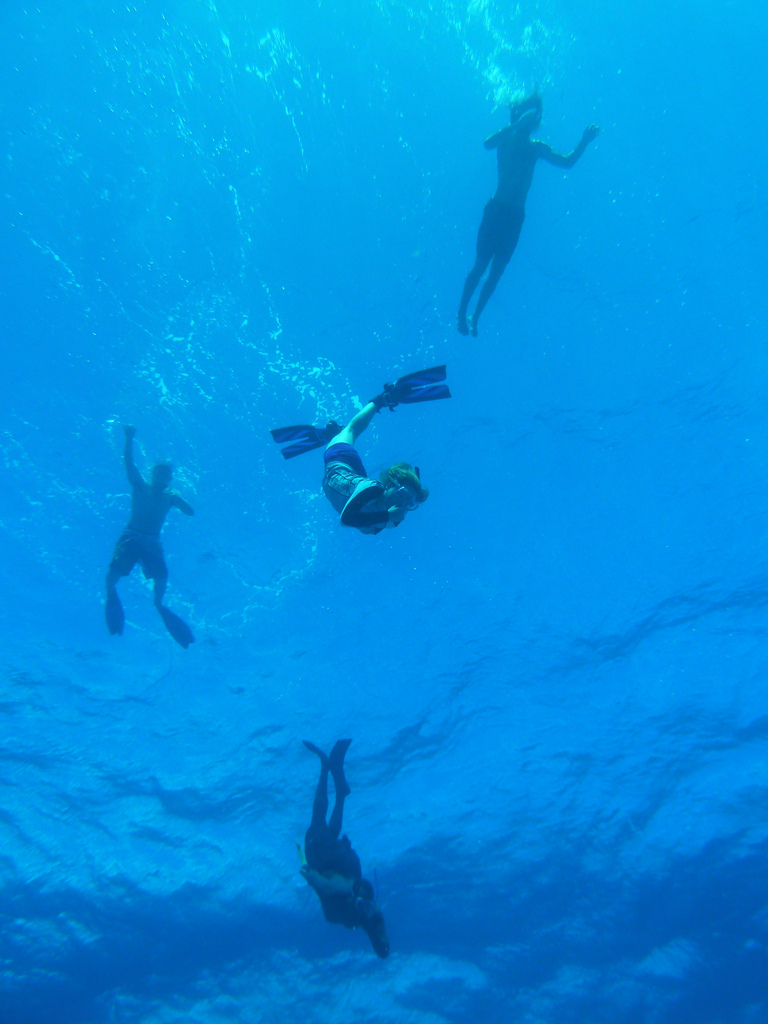
I take a deep breath in and invert, diving down into the water. The sounds of voices and waves gently lapping vanish. My sense of touch becomes universal, my body completely enveloped by water. The lack of other stimuli highlights the brilliant colors of the reef below me. I slowly kick my fins, back and forth, forcing myself to descend at a controlled pace while my buddy watches me closely from the surface. Thirty feet below me, there is an opening in the rock surrounded by small fish. I approach it, and hesitate. Beyond the opening, there are twenty-five feet of tunnel with coral on all sides of me, and no way to come up for air. I weigh my options. Turn away, make an excuse, and say I’ll do it next time, or push myself through. After a few seconds of wavering, I move forward and enter the tunnel. All of the tension washes away. It’s over now, because there is no turning back. I have to finish.
As I swim through the water, I look over to the side and see a Gray Angelfish, beating its pectoral fins, and staring at me, fascinated. I pass it, and begin to feel the urge to breathe. I ignore it and concentrate on the beauty of the tunnel, all the while kicking my fins. Not only is it a unique place, teeming with sub-tropical life, but I am seeing it from an unnatural point of view. Part of its beauty is the idea that I am in a place that humans do not belong, a place where I cannot survive more than a couple minutes. I do my best to get lost in this feeling.
I get yanked out of my trance as my hearing snaps on again. I hear a gulping noise, as I involuntarily attempt to breathe. It happens again, and again, as I near the end of the tunnel but I feel secure knowing my limits and that I’m being closely monitored by my instructors. I see light pouring through the hole, and slowly swim out. As I begin to ascend, I force myself not to try to breathe, and spin in a circle, a small school of yellowtail snapper catching my eye. My lungs plead for oxygen, but I slow down even more, barely moving, pushing myself to relax and enjoy the last few moments of this experience. A few bubbles escape my lips, and they trickle upward, racing each other to the surface. I take my last few kicks and break the surface. I am greeted by the sounds of the waves and the smell of seawater. I fully exhale, completely emptying my lungs, before finally taking a deep breath in.
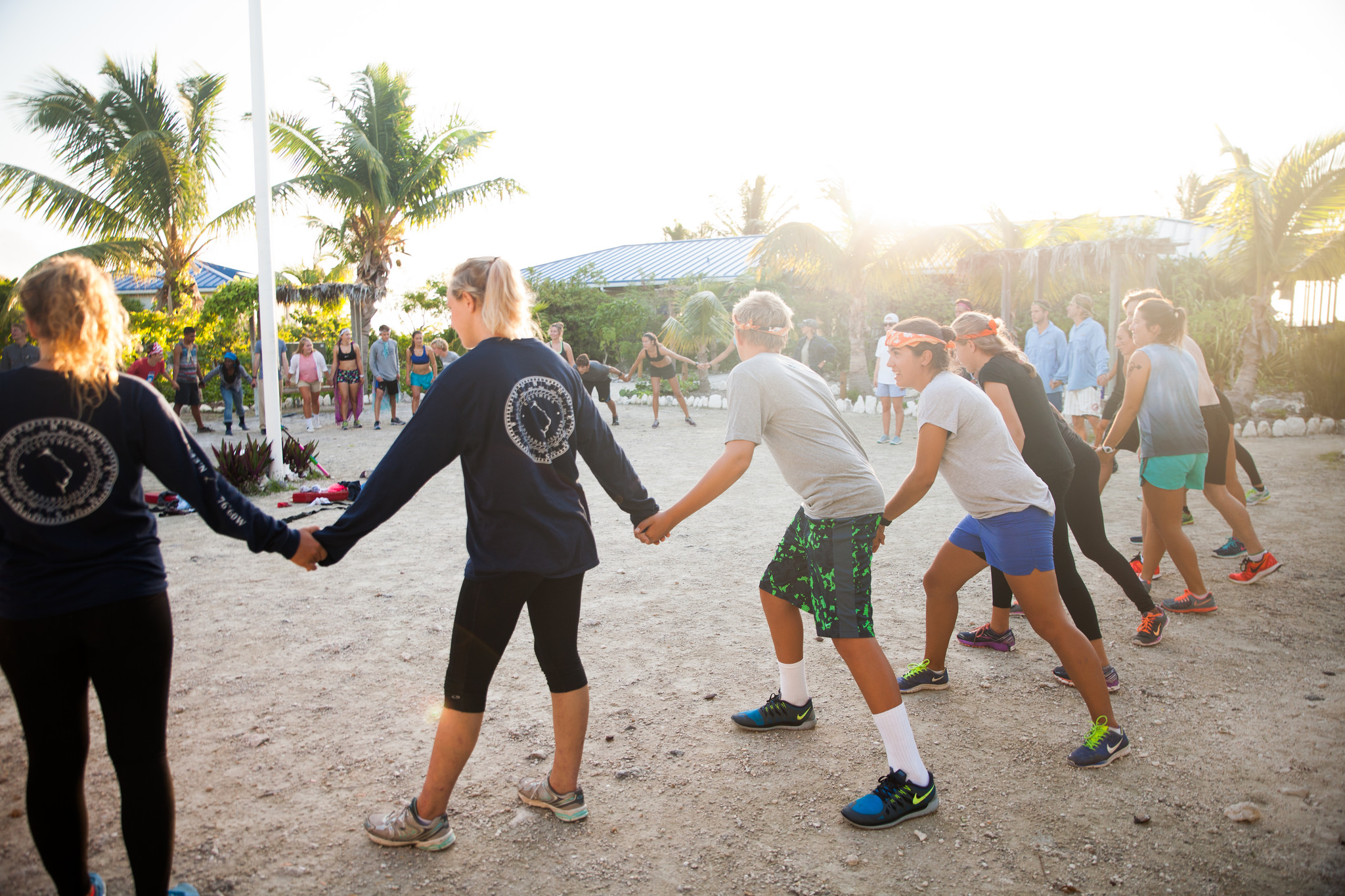
Who knew such a strong community would turn against each other? Last Friday for our morning exercise we played an Island School version of The Hunger Games, students were excited for a break from swim and run track exercise. At the end of morning circle all students held each other’s hands and waited for the words “May the odds be ever in your favor.” Once those words were said the students, along with some faculty and CEI employees scattered around campus.
Students hold hands and get ready to rush into the “Cornucopia” after circle
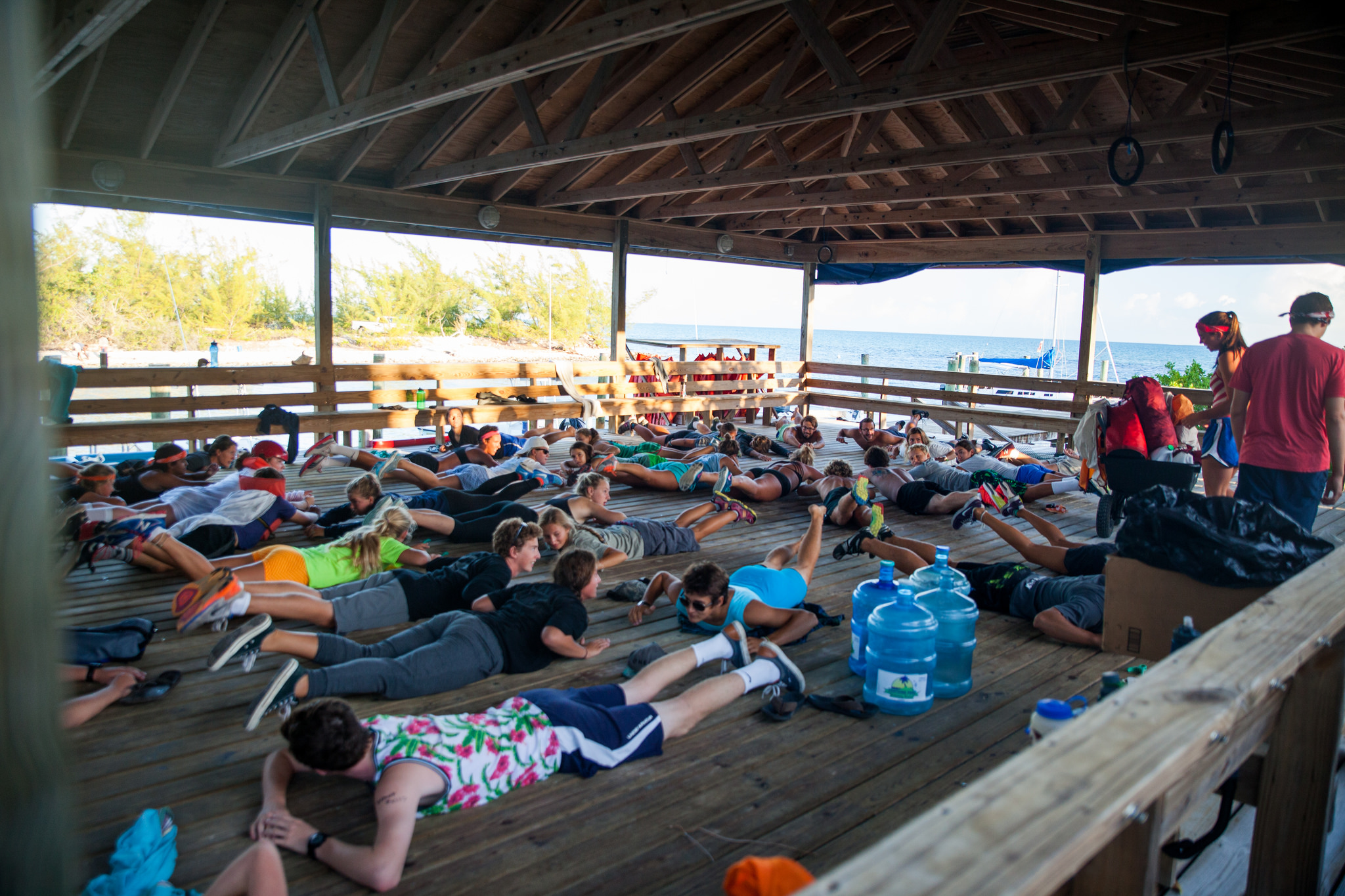
The middle of the circle was the “cornucopia” containing the games’ “weapons”: wet socks and rags with a couple of water guns and water weenies. Some teams’ strategies were to run straight for the “weapons,” but many got out pretty quickly while others ran for cover. Once you were hit with a sock or rag you had to go to the “house of pain,” in the boathouse (an abs workout until there was one team left.) After the each game was over another began. The competition was fierce but we all had a lot of fun. Check out our Island School Flickr page to see more pictures of the games and ISFA 2015!
The “House of Pain,” also known as ab-track in the boathouse
Quick! On the count of three, name every shark you can think of. Okay… one, two, three, go!
If you had the shark knowledge that I had three months ago, you would probably be able to name great white sharks, hammerhead sharks, and maybe bull or tiger sharks. Or maybe you could also name nurse sharks and whale sharks.
But things have changed. I’m now a part of CEI’s shark team in the Deep-Sea Shark research group. We’re looking at Cuban dogfish and their vertical migration patterns. Cuban Dogfish are roughly 2.5-foot-long sharks that spend the night in really deep water and the daytime in even deeper water. What’s really cool is that this is the first study assessing vertical habitat use in Cuban dogfish.
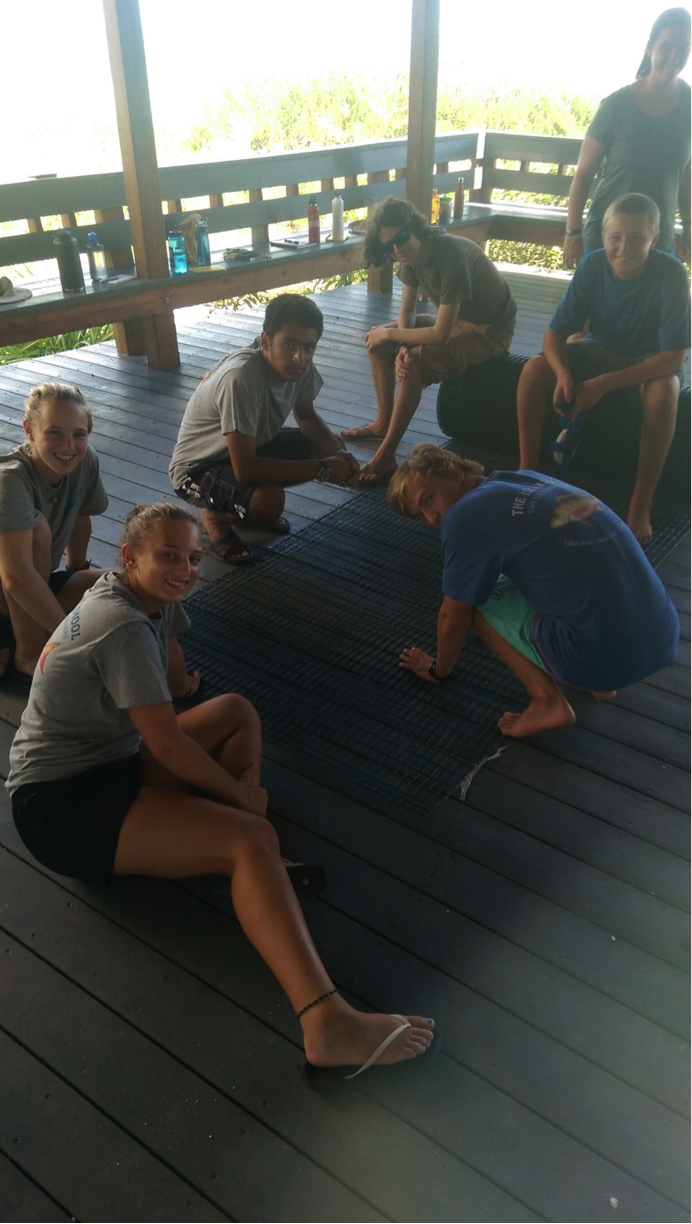
Deep-Sea Shark Research group building “Loch Ness,” their shark cage.
It’s clear that the research we, the students, are doing is actually helping. On one of the first days of research, we were shown a cage design used in releasing wild fish. We were told that we had to design a similar cage in order to protect our sharks from being eaten when we lower them down to release them. So we spent the first few classes brainstorming ideas and then actually went out to cut the wiring and secure everything together. And when we finally finished, we stood there, looking at our cage (affectionately nicknamed “The Loch Ness”) and realized that we had just made something with our own bare hands that would help a real-life research program.
Three weeks into research class we caught our first shark. After spending a week or so building our cage, we were pumped to go out and actually see a shark. But it wasn’t until our third trip out that we were lucky enough to see one, and I think the wait made it even better. When we saw it being hauled up on the line, we were all super excited. Once it was brought onto the boat, it was a rush to take all of its measurements and tag it in the least amount of time possible. Then we put it back in the water, in our little cage that we had brought out, and carefully lowered the shark back down.
After that day, we had two or three other successful hauls. Once, we even caught 7 sharks on one line!
Then, a few weeks ago, we started getting the data from the tags back. Since then, we’ve been analyzing it and trying to find patterns. We’ve found that Cuban dogfish have a large range of depths, from 230m (about 750 feet) to more than 1000m (about 3,200 feet) – that’s more than half a mile underwater!
If you asked me now to name types of sharks, I could go on for a while. Cuban dogfish, lemon sharks, bluntnose sixgills, bigeye sixgills, gulper sharks, nurse sharks, bull sharks, Caribbean reef sharks, and blacktip sharks, just to name a few that live around Eleuthera. And now that we’ve attached a camera to our cage we can see what happens to our sharks when we release them. It’s so cool to take a step back and think about what we’re doing here: ground-breaking research, discovering new things almost every day. It’s sappy to say, but this is such a ‘once-in-a-lifetime’ experience, and I’m so glad that I get to be here for it.
“EVERYBODY WAKE UP!!” It’s 3 AM. I have to pull myself up, like I’m stuck between a 10 pound magnet and a fridge. I am on a rocky boat anchored off some island in the Exuma Sound. I have slept on a boat for the past couple of nights now, and have grown accustomed to the 30 minute night watch and stiff boards underneath me. I have to attach myself to the boat to keep myself from being swept up by the waves in sleepiness. I’m groggy and annoyed, but the calling of land motivates me enough. A few days before we spent 11 hours sailing across the Exuma Sound. We dedicated the past couple of days to exploring the islands; we saw a plane wreck, jutia rodents, rare iguanas, and that was just the beginning. We had a big day ahead of us, navigating a 6 hour route back across the Exuma Sound.
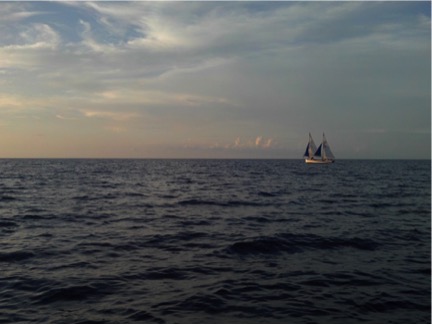
Island School and Hurricane Island Outward Bound partnered this fall to send half of Fall 2015 out on sailing trips during the 8-day expedition rotation.
After 6 hours of hard work, we saw it. Land. It was a momentous occasion of celebration. We did it. We made it! It was so close! Just a little while longer and we would be on land. 6 hours turned into 7. 7 hours turned into 9, snowballing into 14 hours of sailing. It was so close I could feel it, but the day kept dragging on. There was nothing we could do. It was all up to the wind, but it was definitely not in our favor that day. So many words were said with little vigor, “jiving,” “tacking,” “falling off,” “sheets are luffing” “pull the foresail in.” These phrases were all foreign just a few days ago but had been so engrained that it didn’t matter how tired I was. My hands moved in whatever way needed and my body followed. After many nap rotations, snacking sessions, sleep-deprived moments of sass, and bursts of shivering from rogue frigid waves, we arrived.
The land that we were approaching was not near my bed, but rather an empty beach where we would embark on our long-anticipated solo. After being on a boat for several days with a similar group of people, humans and boats were the last thing I wanted to see, or so I thought. As soon as I stepped off the boat into the known land, I wanted to return. The ocean had engulfed me. The open waters, the unknown, the freedom of the openness called my name. Sailing after solo was like taking a breath of air. Sailing with these people and the open ocean had become my joy. I had never been on a boat for more than a few hours before, but after these couple of days, it was all I could think about. Even though I have returned to land for the time being to explore the island, the ocean will always call me, and soon I will answer.