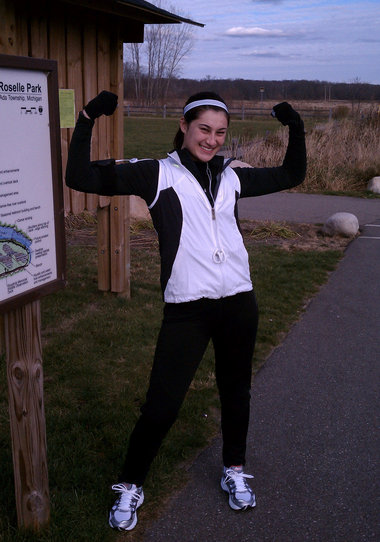
Maddie Hawk, an alumna of Spring 2010, will be running a marathon and swimming a 10K during her spring break to raise awareness of global water issues. Check out this great article here about her cause. Good luck Maddie!

Maddie Hawk, an alumna of Spring 2010, will be running a marathon and swimming a 10K during her spring break to raise awareness of global water issues. Check out this great article here about her cause. Good luck Maddie!
Everyday we tell ourselves things: words to live by, bits of wisdom we’ve heard before, the things our parents told us—still tell us today. We tell ourselves what we need to hear to persevere, to lead, to succeed, and to sometime just simply be okay. Bits of wisdom circle our heads like bat moths gathering around a ceiling fan. We pluck a wing and remind ourselves of a truth we already know. We tell other people things too: like breathe, or this is supposed to happen, or we make each other laugh, which is another kind of wisdom.
Last week I got to thinking about these things. As the orientation drew to a close for the spring 2011 semester (the 25th group of students who have embarked on this wild journey), I was thinking about what words I wanted to share with them to inspire them to preserver, to lead, to succeed and to just simply be okay, in the months to come. And I realized the words they needed were not my own, or at least not only my own. So, I embarked on another wild journey: I attempted to collect one single piece of advice for the S11 semester, from each member of the Cape Eleuthera Foundation. Continue reading

Ten students and three chaperones from Lin-wood High in New Hampshire recently visited the Cape Eleuthera Institute for one week of exploration and education with the Educational Program’s team. The “Lin-Wood crew” were happy to escape their wintery weather for some time learning about our local ecosystems, sustainability initiatives and research.
The group, led by Rebecca Steeves, a teacher who worked at DCMS for 5 years, got the opportunity to learn about our vital mangrove swamps, the threat of invasive lionfish on local reef ecosystems and some of our local developmental issues and challenges. We also managed to spend time helping a team of locals from Bannerman town who are converting the old abandoned school building into a public library for the area. Continue reading

The Educational Programs team has been at it again with back to back courses over the past two weeks. First up, eighteen students from Branson High School in the Bay area of California visited us for a week long stay. Branson’s stay here was, as usual, a whirlwind event, with both the students and instructors dropping gratefully into bed after each full day of research, exploration and adventure. One memorable moment we were fortunate enough to experience was camping on the beautiful Jack’s Bay beach under a perfect starry night sky. Sadly, due to the development of a new golf course in the area, we were unofficially the last group ever able to camp at that beautiful location. Continue reading
by Caciques Evan and Emma
[slideshow]By just the 9th day at The Island School, “home” has taken on a new meaning. K1 and K2 made a triumphant return from our 3-day kayak expeditions feeling as though we had arrived home. It seemed as though the buggy beaches and the strenuous kayaking had accomplished something other than giving us itchy and tired arms—it created a family-like bond where everyone knew that together, the impossible could in fact be possible and any challenge could be overcome. Everyone had returned tanner, physically and stronger, mentally; and more excited than when they had left about the prospects of attending The Island School. Continue reading

The aquaculture team is gearing up for this semesters research and that means setting up a new study design. The 1,500 cobia that we have in the lab were randomly separated into 6 different tanks. The 3-phase plan took an entire day but all the fish were divided safe and soundly. We made a last minute change in our plans for the Island School research class and are now looking at how the cobia will perform on 3 different feeds. Continue reading

With people coming in and out of The Island School and CEI so frequently, the sharing and transferring of responsibilities is an integral part of ensuring that the good work being done continues beyond one individual’s journey. I have worked as the permaculture intern for the past two months and though I’m sad to say goodbye, I know that the 2011 spring semester will bring positive change, new research, and creative energy to The Island School campus. As I prepared for my departure over this past week, I began transferring my most well known, and perhaps most important, duty to the students. Pictured above are students Aldis and Sarah bottle-feeding Shadow, who at 7 weeks of age is almost all grown-up and ready to be off his milk diet. Until then, he will be well looked after by the students, who after less than one week on Cape Eleuthera have already stepped in and stepped up to the plate on their journey as leaders.
Wishing the whole Island School community a fantastic spring semester,
Kelly McGlinchey
This semester the Island School students on the Flats Ecology research team will be learning different techniques for catching, measuring, and tagging bonefish. This valuable information will be a great resource on growth rates, survivorship and movement patterns of bonefish. Recently, tagged bonefish from Florida have been found here in The Bahamas! This fact brings up interesting questions on migration patterns and physical differences between bonefish in Florida and The Bahamas. Students will be getting an opportunity to seine and fly fish with the flats ecology researchers, helping gather information that will then be a resource in conserving and protecting bonefish fisheries.
Sunscreen Causes Coral Bleaching
The Cape Eleuthera Institute intern book club is where the interns, fellow CEI researchers and IS community come together every Thursday evening to review scientific literature. Past topics include bonefish mortality rates in catch and release fishing and food security in the tropics, this week’s paper discussion investigated the effects of sunscreen on coral reefs and their symbiotic algae, zooxanthelle. A majority of the book club was aware that of the potential negative impact sunscreens could have on coral reefs, but were not sure to what extent.
The study subjected hard coral species, Acropora, to several different concentrations of sunscreen ingredients, including ultra violet filters and preservatives, where they were evaluated for their coral bleaching potential. The results clearly show sunscreen ingredients caused coral mucus to be released leading to loss of membrane integrity and photosynthetic pigments in zooxanthelle. It was determined, even at very low doses, sunscreens cause rapid and complete bleaching of hard coral within 96 hours. Continue reading
Last fall, Alexandra Cousteau visited The Island School to film this segment for Revo sunglasses. You’ll recognize a lot of the scenes in the clip! It was great having Alexandra on campus – we hope she’ll come back and visit us again soon.